

Somatic Attachment in Practice: What We’re Really Observing in the Body
For trauma‑informed practitioners who already track the nervous system and attachment, and want a clearer way to read how attachment is written through the body in real time.


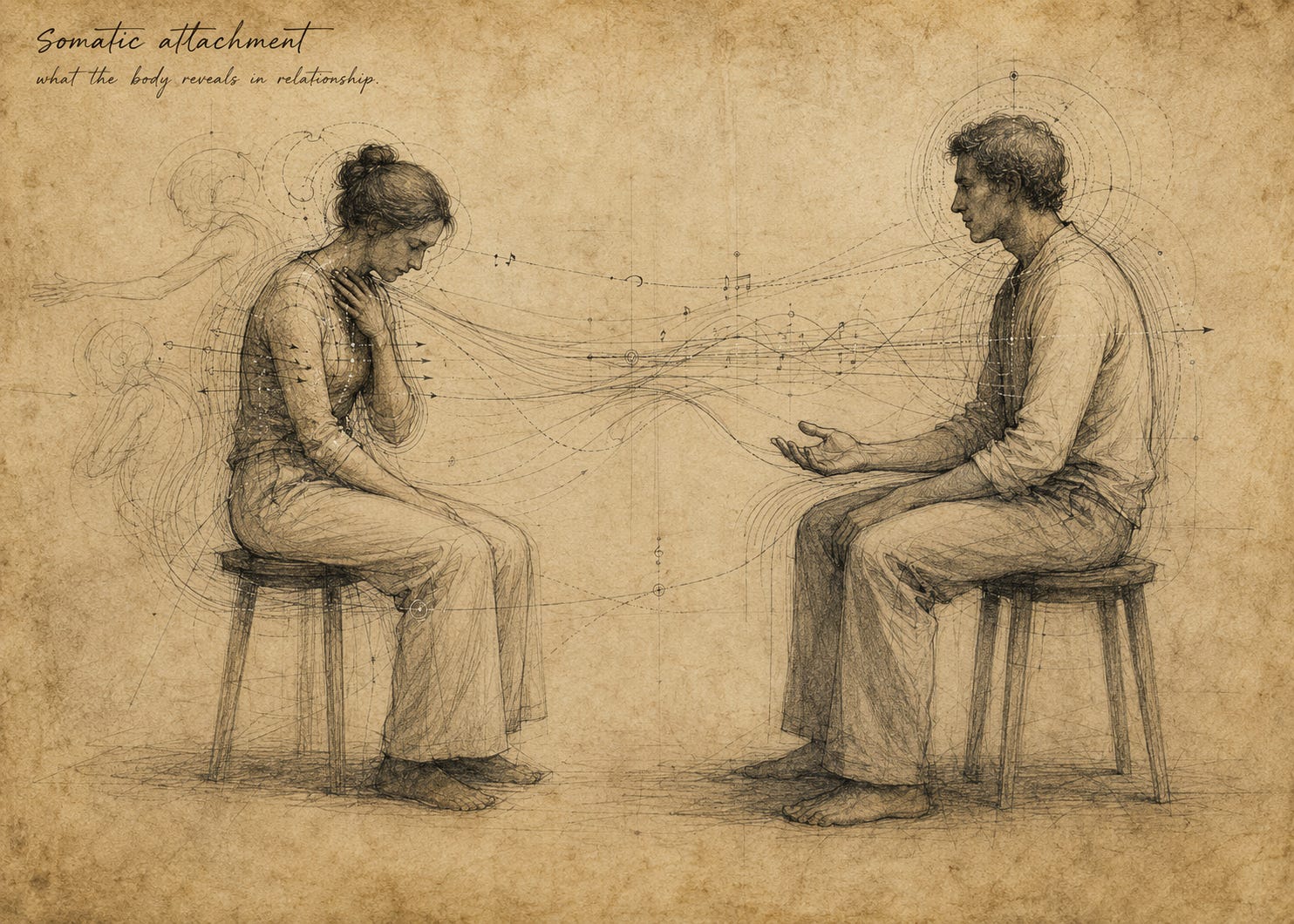
The Forming Body
I write about somatics, trauma, attachment, and the physical architecture of being human. This is where I think through the questions that orient my work: How do we become who we are? What does it cost to survive? And what becomes possible when survival is no longer the only goal? Weekly essays for practitioners who want substance over comfort.
If you’re working with people, I’m sure you’ve had a situation like this happen during a session with a client. Imagine you’re in a session with a client and they begin the session by sharing something that sounds pretty simple, almost benign…
“We had another fight last night.”
You’ve heard this client say this many times in your work together, so it doesn’t come as a surprise. You know that if you wanted to, you could use a few different interventions, like communication skills, cognitive reframing, or working through the conflict cycles. You could ask about the content of the argument, you could reflect the feelings they’re expressing, you could help them see the pattern that’s been repeating. All of that would be legitimate, useful work. But as they continue telling their story about what happened, you notice that the content of the story is the least interesting thing happening.
As they say “another fight,” you notice that their breath shortens almost imperceptibly. You’ve been training to notice these small cues. When they mention their partner’s tone of voice, one hand comes to rest on their throat and stays there. As they describe “trying to explain” and “not being heard,” their chest begins to narrow, and their shoulders drift forward, as if closing over something. Their eyes, which met yours at the start of the session, now slide to a fixed point on the floor somewhere between the two of you.
None of this lasts more than a few seconds, but it all catches your attention. To your client, it may not register as anything at all. They’re immersed in their own experience, unaware of what they’re doing with their body.
To you, if you are attending somatically, it is a dense field of information. You recognize the breath change as a nervous system event, an autonomic adjustment that started before they had time to think about it. You recognize the hand at the throat as a marker you have seen before with this person, a familiar gesture that appears whenever something wants to be said and does not quite make it to the surface. You recognize the postural narrowing as a shape that has history, not a one off reaction to last night’s argument. And you recognize the shift in the eyes as a relational movement, a moment in which contact with you becomes more dangerous than looking away. You also recognize that none of these layers is separate from the attachment story they are telling, and none of them are a problem.
This way of organizing breath, posture, gesture, and gaze did not begin with this partner or this argument. It is the present tense expression of a much older template for this person. It’s the physical shape of how this organism learned to manage proximity and distance, need and disappointment, protest and collapse, in the presence of people it depended on. It is attachment, not as a category on a diagram, but as an ongoing somatic choreography unfolding in real time in front of you.
If you read only the narrative, there’s still a lot you can do. If you read only the nervous system, you can do good work with this client as well. If you read only the attachment style, you can do good work. But something essential about the way this person forms themselves in relationship will remain unattended until you begin to recognize how these layers organize together.
What has just happened in a few seconds is already multi-layered. The breath belongs to the autonomic state, to a rapid adjustment in arousal and defense that precedes thought. The hand at the throat belongs to procedural memory, to a well rehearsed motor sequence that organizes around not saying something. The narrowing through the chest and shoulders belongs to the formative history of this body, to the way structure has grown around repetition of a particular kind of effort, interruption, or bracing. The shift in the eyes belongs to the attachment field, to the live negotiation of exposure, dependence, and safety between one person and another.
These can be named as if they were separate channels. In reality, in a living system, they do not function that way. One organism is solving one problem–how to stay connected enough to preserve attachment, and protected enough to survive it. The solution appears simultaneously in breath, in muscle tone, in gesture, in posture, in attention, and in narrative. When you learn to read them together, your sense of what attachment work actually is begins to change and you can see the intricate nature of a living system – the soma.
The autonomic layer is the most immediate and the least voluntary. In polyvagal terms, this is neuroception at work, the nervous system detecting threat or safety in the remembered argument and in your presence, and shifting state accordingly before the client has any conscious sense that a decision has been made. The small change in respiration, the slight tightening at the ribs, the way the exhale shortens, are the organism moving along familiar pathways of mobilization or shutdown. You are not just watching anxiety. You are watching a practiced adjustment in the distance between activation and collapse, calibrated over years of relational experience.
Close on top of that sits the procedural layer. The hand to the throat is not random. The client does not decide, “I will now signal that I am silencing myself.” The body has learned that when certain feelings or impulses arise, tightening this segment, covering this area, organizing these muscles, keeps them from becoming action. This is procedural memory in the sensorimotor sense. Think about it as learned sequences for managing impulse and contact, laid down early, refined over time, and now running outside of conscious choice. In a different client, the marker might be jaw muscles that clamp or tighten, a leg that starts to bounce, a foot that angles toward the door, or something else. Each is a micro action that belongs to a longer, older pattern of approach, inhibition, or escape.
The postural layer expresses an even longer history. When the chest narrows and the shoulders drift forward, you are seeing more than a simple mood shift. You are seeing the body returning to a shape it has practiced so often that it has become normal. Formative work makes this function of body shape explicit. Under chronic conditions, temporary responses become semi permanent organizations. A startle that never fully resolves, a bracing that is always slightly on, a collapse that is never fully recovered from, will shape tissue, alignment, and the felt sense of occupying one’s own mass. Over time, the emergency solution becomes the person’s default shape.
This is where early movement and early holding enter the picture. Long before there is a coherent attachment narrative, there is yielding into support or failing to yield, there is pushing into the environment or not finding enough ground to push against, there is reaching and grasping that meet contact or hang in space, there is turning toward faces that light up or go flat. Primitive reflexes and basic neurocellular patterns do not integrate in isolation. They are completed or interrupted in a relational field. When an infant is consistently lifted before they can push, or left without enough support to extend, or flooded beyond their ability to orient and recover, the body learns something about effort, initiative, and reaching others that will later be read as “attachment style,” but is already inscribed in movement and the body’s living process.
Developmental movement work has been observing this for years. The way a child learns to roll, to come up, to reach, to pull themselves toward, to crawl away and return, is always happening with someone. The caregiver’s timing, touch, availability, and own organization around contact become part of the child’s motor repertoire. When early reflexes integrate in a context of reliable support and tolerable frustration, the organism experiences that movement toward others can complete. When they are chronically interrupted or overloaded, the body learns that certain impulses cannot be followed through. By the time your client sits in front of you describing an argument, that whole history has been condensed into the way their trunk organizes when they speak, the degree to which they can occupy their own weight, the precision or vagueness of their gestures, and the speed with which they inhibit their own reach. Attachment does not appear on top of this as an abstract psychological event, or style. Attachment emerges through it as a living organizing process that’s constantly moving and adjusting in response to the world and their history.
The relational layer is often the most visible and the most easily flattened. Eyes that leave contact at the moment feeling intensifies, a voice that flattens when dependency enters the content in discussion, a body that leans forward during a complaint and pulls back when you are available, are all ways of managing the edge between wanting and fearing proximity. This is where attachment language about approach and avoidance, protest and detachment, can be useful, as long as it is grounded in what you are actually seeing happening. When the client breaks eye contact right as they say, “I really needed him to…,” you are watching the point at which the system has learned that expressing need and staying in connection is too expensive. That tiny shift in gaze is the present tense expression of a threshold that was established long before this partnership. It’s their history written in their self organizing process.
Once you begin to organize your perception along these lines, it becomes difficult to imagine that any one layer is optional in your approach. If you work only at the level of autonomic state, you will have more regulation tools, and you may widen the client’s window of tolerance. But if you do not see how their body has grown around incomplete early movements, if you do not recognize that their chest always narrows when they approach genuine contact, if you do not notice that they routinely abandon their own gaze at the moment need comes into the room, you will reach a point where state work alone stops changing the pattern.
If you work only at the level of attachment category, you can name the pattern and perhaps shift some of the narrative, but you will not be working where the pattern is literally held. The client will be able to tell you, in articulate terms, that they oscillate between clinging and withdrawal, that they fear abandonment yet cannot tolerate closeness, that they repeat the same cycle in every relationship, but their hand will still be at their throat whenever they start to say, “What I really wanted was…,” and their body will still have no lived experience of persisting in reach and having that reach met. Insight will sit on top of procedural and structural organization that has not yet been engaged.
If you work primarily with structure and movement, you can do profound things with support, alignment, and access to impulse. You can help a client sense their back, occupy their feet, find ground for pushing, and re-discover their ability to extend. You can change the physical conditions under which they experience relationships. But if you do not see that the way they curl their chest is specifically linked to their expectation that anger will cost them connection, if you do not recognize that their reluctance to lean back into the chair is tied to a history of support failing at exactly the moment they let go, you risk treating form as if it were only about gravity, when in fact it is also about the memory of other people and the way someone learned to survive.
Your own body is woven through all of this, too. Your autonomic state shifts when theirs does. Sometimes your breath unconsciously matches the shallowing of theirs. Your own chest narrows as they begin to recount the fight. Your eyes feel the pull to look away at the same time theirs do, or you notice an impulse to lean in and rescue, to offer an explanation, to soften what is hard to say. These are not background disturbances to be pushed aside in the name of neutrality. They are part of the relational field being co created, and the very thing that sets good practitioners apart from great practitioners.
Your action tendencies are formative material. The urge to fix, to organize, to slow down, to speed up, to over explain, to back away, to soothe prematurely, is often your body’s way of responding to the same attachment choreography that is moving through the client. If you can feel those impulses without having to enact them, they become incredibly useful data for you. If you cannot, they become part of the reenactment pattern. Practitioners who do not yet have sufficient somatic literacy with their own organization tend either to enact these pressures or to defend against them conceptually. One person becomes excessively active and tries to regulate what the client cannot yet regulate. Another becomes interpretive too soon and relocates the work into cognition. Another withdraws into observational distance and mistakes detachment for steadiness. Another over identifies with the client’s collapse or protest and loses discriminative capacity.
Over time, with enough personal work and supervised clinical hours, a different capacity can begin to mature in you. It is less about having the right technique and more about how much complexity you can hold without forcing it into one explanation. The capacity required here is not just empathy, nor attunement in the broad sense, nor technical knowledge in isolation. It is the ability to remain organized enough to perceive multiple strata of experience simultaneously, without reducing one to the other and without moving prematurely to intervention. To notice, for example, that a client’s explanation is cognitively coherent while their breath is becoming shallower, that their posture suggests inhibition rather than simple sadness, that their gaze is leaving contact at the moment dependency enters the story, and that your own body is beginning to prepare to bridge the gap for them. That kind of perception is trainable. It is not merely intuitive. It may begin as intuition, but can absolutely be trained.
With practice, this multi-layered listening starts to feel like listening to complex music. In the beginning, you hear everything as one sound. Then you begin to distinguish threads. Eventually, you can hear several instruments at once without losing the whole. In professional terms, you can register the autonomic shift, the procedural gesture, the structural form, the relational movement, and your own response at the same time, without collapsing them into a single narrative. You can hear the parts and the whole together.
Once it is developed, your options expand. What looked like resistance may reveal itself as a protective sequence with specific developmental roots. What looked like dysregulation may prove to be an organized attempt to manage unbearable proximity. What looked like poor communication may be the endpoint of interrupted orienting, constricted mobilization, and a procedural expectation that direct expression increases danger. The practitioner is no longer choosing between attachment theory, nervous system work, or somatic process. They are reading a single event across the channels through which it is actually occurring.
This is also where the ceilings of single framework approaches become very visible. State based work can improve regulation while leaving relational expectancy untouched. Attachment based work can produce insight while leaving procedural action patterns unchanged. Structural work can alter support and alignment while missing the attachment meaning of the change. Parts work can clarify internal conflict while under reading the bodily organization through which those conflicts are enacted. None of these limitations invalidate the frameworks. They simply mark the edges of what any one lens can reliably do alone.
The difficulty becomes especially clear in attachment impasses. A client can track activation beautifully and still enter the same relational collapse when need becomes explicit. They can understand their avoidant defenses and still lose access to impulse when closeness is offered. They can soften chronic bracing and still experience contact as disorganizing because the procedural and attachment layers have not yet been integrated. They can name protest, shame, fear, and longing while the actual sequence of breath inhibition, throat holding, gaze aversion, and aborted reaching remains unworked. At that point, progress appears partial because it is partial. One layer has changed while others continue to organize the outcome.
This is where many capable practitioners start to feel the “cognitive ceiling” of talk and the limits of what their existing tools can reach. They know how to reflect, reframe, and resource, and they can feel that something deeper is running the show. They describe sessions where they are doing everything they were trained to do, and the client still circles the same material. They notice themselves walking on eggshells around trauma content, not because they lack care, but because they are not confident they can help a client come back if something big opens. They leave certain sessions drained because their system is simply working too hard.
What begins to resolve that sense of “something is still missing” is an integrated way of reading and working that matches how the human process is actually organized. A way of perceiving that lets you see where the pattern is being held right now, and what would be the smallest, most precise layer to touch without overwhelming the system. For some practitioners, this is the point where they start looking explicitly for somatic training that goes beyond basic nervous system language and generic embodiment cues. They are no longer satisfied with adding one more modality on top. They want their work to feel coherent, effective, and safer, both for their clients and for themselves.
Building that kind of capacity does not happen from simply learning more theory. It’s not going to happen by reading another book or going through another self-study course. It happens in sustained practice, in contact with real people, in environments where you can slow the process down enough to see the layers and get feedback on what you are noticing. It requires a field where it is safe to name what your own body is doing, to explore the developmental and attachment histories that shaped your own patterns of approach and withdrawal, and to experiment with interventions that address different layers without losing the whole.
Practitioners who train this way report very specific shifts. They feel less under equipped when trauma surfaces. They feel clearer about how to stay within scope and “do no harm.” They feel more confident working at the depth where talk had previously hit its limit, because they are no longer flying blind in their work with clients.
This is the feedback we get continuously from our students.
For many, there is also an unmistakable personal change. The same skills that allow you to read your clients more precisely allow you to recognize your own thresholds more honestly. You become more aware of when your body is beginning to collapse or brace in response to your caseload. You can intervene in your own patterns with the same developmental and attachment lens you bring to your clients, which is one reason practitioners so often say that this work has changed their own life as much as their practice.
If you are already attuned to the nervous system, already fluent in attachment language, already tracking movement or structure in some way, then you have been sensing these layers all along. The work of somatic attachment is not to give you an entirely new set of perceptions. It is to name and organize what your body has been reading, to connect those readings to their developmental and relational roots, and to extend your range so that you can meet what you see with more precision and less strain.
If you want to keep following this thread, there are earlier pieces in this series that sketch the somatic foundations of attachment and the role of proximity in organizing the nervous system and relational field. They lay out how early contact, distance, and support shape not only belief, but also movement and form across the lifespan.
When you are ready to move from understanding into practice, Attachment and Somatics is where this becomes a lived skill. It is a forty hour certificate training in attachment‑focused somatic work, designed for practitioners who already work with trauma and want to go beyond the ceiling of talk into the layered choreography you are reading in your clients’ bodies. Across the training, you work with live demonstrations, guided practice, and structured feedback so that you can deepen your capacity to read multi layered attachment patterns, expand your options at relational impasses, feel more confident when trauma material surfaces, and hold your own system steady enough that this work remains sustainable for you over time.
If you are looking for a place to keep practicing after that, The Somara Collective exists for exactly that reason, an ongoing space where somatically informed practitioners can bring real cases, continue to refine their perception and skills, and stay resourced in community.
And if you are just beginning to explore this territory, the free Somara Community offers teaching, resources, and a wider field of colleagues who share this commitment to working with the body and attachment as they actually appear in practice.
If you appreciate this work and want to support its continuation, consider becoming a paid subscriber. For $8/month, you’ll receive the full weekly series including Friday’s long-form essays, access to the complete archive, and the ability to participate in our comment conversations.
Ways to work with me:
The Somara Community – The free public-facing home of the practitioner network. Curated somatic resources, weekly teachings, and a global community of practitioners. No cost, no commitment.
The Collective – A monthly membership for practitioners building a somatic culture. Four live experiential somatic practice classes per month with expert faculty and rotating global guest teachers, plus lifetime access to all recordings and the full resource library. $57/month or $470/year.
Foundations of Trauma + Somatics – A self-paced mini-course in the foundations of trauma and somatics. Nervous system literacy, somatic awareness, and trauma-informed principles. One-time payment for lifetime access. $299, plus a $750 discount on the T+S training once completed.
If you have a question or topic you’d like me to explore, leave a comment below. I read them all, and they shape what I write.
Thank you for bringing your attention here. In a world that pulls us constantly toward distraction, your presence matters.
 | A guest post by
|
Loving all your content!
This really resonated with my own experience. I am not a practitioner, but I am a student of msc psychology (Kings College London via online)
After being diagnosed with a chronic autoimmune illness years ago, I noticed my body started reacting very differently. Even during ordinary conversations, whether with family, friends, or colleagues, my nervous system seems to shift into survival mode automatically. My heart races, my face, neck, and chest become visibly flushed, and I can literally feel the surge of blood through my body. It also happens when I become emotional while watching a movie or even when I’m alone crying. It feels like my body perceives emotional expression itself as a threat, even when my mind knows I’m safe.
I’ve tried CBT, but it feels like this goes deeper than changing thoughts. It seems as though my body learned this response and now activates it automatically.
I’m curious, based on your work, how do you think patterns like this can actually be reversed? Have you found approaches that help retrain the nervous system when the body seems to react before conscious thought?